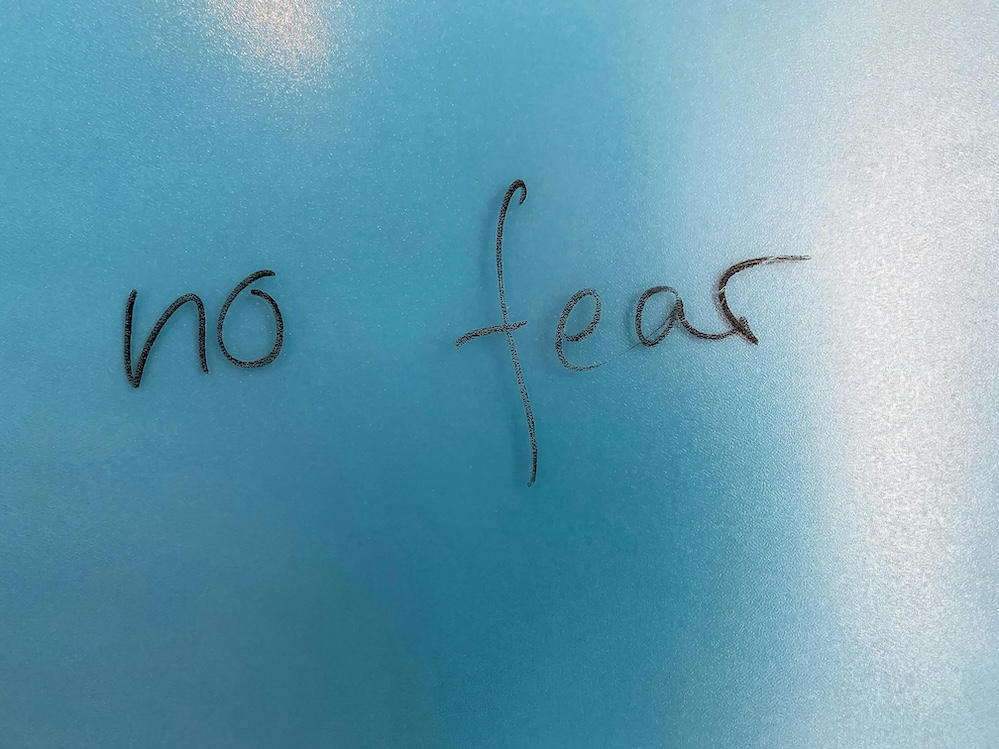
I’m continuing with the post-Paul Selig Retreat posts because I think, taken together, they offer a real prescription for moving forward in today’s world in a more enlightened way, with far less fear. Just a few more posts to go. This one continues our discussion of fear.
I’ve learned that he teachings of Paul Selig’s Guides ask that we stop mistaking fear for who we are.
Because truth is, fear is behind many of our actions.
And as long as fear is the authority, separation becomes the lens—and everything we see, choose, and create reflects it. That’s pretty profound. So let’s unpack it:
The fear we call “self”
Most of us have been taught to organize our lives around fear without realizing it. Think about it:
• Fear of loss
• Fear of rejection
• Fear of being wrong
• Fear of not being enough
From that place, we construct a “self” that is defensive, strategic, and always bracing for impact. We call it identity. The Guides would call it a misidentification.
They teach that the true self—the Divine Self—is never in fear because it is never separate.
So when we operate in fear, we are not being “just human.” We are being out of alignment with what we really are.
The choice is simple
• Will I see through fear, or beyond it?
• Will I act from separation, or from knowing?
• Will I reinforce the old identity, or allow something higher to inform me?
Most of these choices are quiet. Invisible. Unannounced. But they are not inconsequential.
A life is not built on grand gestures—it’s built on micro-choices of perception.
It doesn’t have to be dramatic, big decisions, turning points or life pivots. The Guides teach us that every.moment is a choice of alignment.
Separation as a habit
Separation isn’t just philosophical—it’s automatically practiced, especially in our culture. Whether it’s immigration, politics, race, religion, gender–if we look at another as OTHER it separates us from them. When there’s no need–we are all humans.
We separate when we say:
• “That person is wrong, I am right.”
• “They are the problem.”
• “This group matters more than that one.”
On a personal level, this creates isolation.
On a collective level, it becomes something much more dangerous.
Because when separation is justified, harm becomes easier to justify too.
War: separation made visible
War begins in small ways:
• Dehumanizing the other
• Refusing to see shared humanity
• Prioritizing identity over connection
It is the culmination of countless choices made in fear and reinforced through separation. Can you see it around us? I do.
By the time these choices become war, the distance between “us” and “them” has been so normalized that destruction can be rationalized.
The Guides’ teaching challenges the foundation beneath that reality:
If you truly know another as not separate from you, how do you harm them without, in some way, harming yourself? You can not. If only we acted on that, set policy on that–or just understood it.
Getting past fear isn’t denial
This is where the teaching can be misunderstood. Moving beyond fear doesn’t mean:
• Pretending everything is fine
• Avoiding hard truths
• Refusing to take action
It means you are no longer instructed by fear.
You may still feel it—but you don’t become it.
And from that shift, something changes:
• You respond instead of react
• You see more clearly
• You make choices that aren’t rooted in division
A different way of being in the world
The Guides don’t offer a quick fix for the world’s conflicts. They suggest a reorientation of the individual—the only place real change can begin. When you:
• Reclaim your identity beyond fear
• Choose alignment, moment by moment
• Refuse to reinforce separation in how you see others
You are no longer contributing to the conditions that perpetuate division.
That may sound small. It isn’t. What if everyone did this?
Because every act of seeing beyond separation introduces something new into the field—something that does not perpetuate the old pattern.
This reorientation and refusal to be in separation is how I knew I was a pacifist years ago. And about the same time, this is how I discovered I am against capital punishment. This is how I realized that an eye for an eye makes the whole world blind.
What we can do
There’s no doubt we’re accustomed to knee-jerk reactions. But that doesn’t mean we have to be driven that way. Here’s what we can do:
Notice when fear is speaking as “you”
• Pause before agreeing with it
• Choose again, even in a small way
• See if you can recognize the other—not as “other,” but as part of the same field of being
This is not about perfection.
It’s about practice. Be patient with yourself. You are undoing eons of conditioning.
And over time, that practice becomes a different way of being—one that is less reactive, less divided, and more aligned with what the Guides would call the truth of who you are.
We may not be able to end every conflict in the world.
But we can stop rehearsing the inner conditions that make them inevitable.
And that, according to this teaching, is where everything begins.
Such simple, difficult wisdom in this, Carol. One complementary feature of war I realized during my years teaching at the Naval Academy, besides dehumanizing the other is a buried need to self-harm. The warrior mentality often features a self-destructive streak … probably, a sad way to prove a worthiness that was never granted in childhood. The character of Ted in A Modest Trumpet Fanfare turns this against his son.
Wow! Lots to take in here. Excellent advice fr everyone. My hardest fear to let go of is the fear of losing lived ones. I’ve lost numerous family members including one of our babies, and also too many pets–it never gets any easier .
Here you’ll find my blog, some of my essays, published writing, and my solo performances. There’s also a link to my Etsy shop for healing and grief tools offered through A Healing Spirit.
I love comments, so if something resonates with you in any way, don’t hesitate to leave a comment on my blog. Thank you for stopping by–oh, and why not subscribe so you don’t miss a single post?

 I’m continuing with the post-Paul Selig Retreat posts because I think, taken together, they offer a real prescription for moving forward in today’s world in a more enlightened way, with far less fear. Just a few more posts to go. This one continues our discussion of fear.
Such simple, difficult wisdom in this, Carol. One complementary feature of war I realized during my years teaching at the Naval Academy, besides dehumanizing the other is a buried need to self-harm. The warrior mentality often features a self-destructive streak … probably, a sad way to prove a worthiness that was never granted in childhood. The character of Ted in A Modest Trumpet Fanfare turns this against his son.
I’d never thought of it that wyay, Molly. And yes, Ted for sure.
All good advice. Tara Brach addresses fear a lot in her podcast. She’s helped me a lot. Check it out if you haven’t already.
I haven’t and will, Laurie, thanks.
Wow! Lots to take in here. Excellent advice fr everyone. My hardest fear to let go of is the fear of losing lived ones. I’ve lost numerous family members including one of our babies, and also too many pets–it never gets any easier .
That’s so right. It never does. We are still grieving our Cutie, hard.