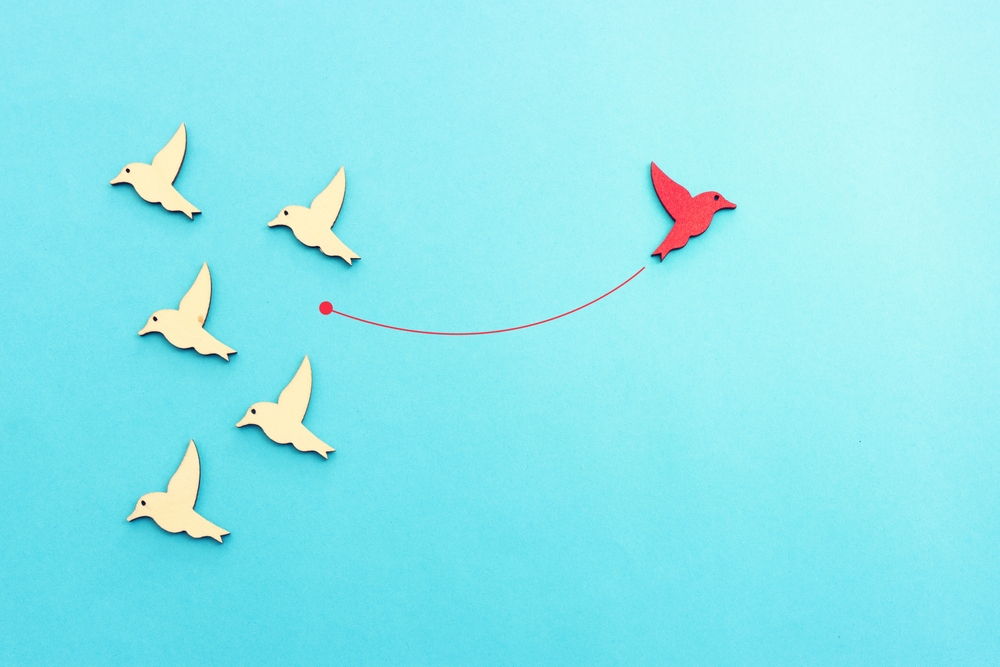
There comes a point—if we’re lucky—when the sometimes exhausting act of fitting in loses its appeal.
Well, more acccurately? It becomes impossible.
Not dramatically. More like a quiet realization that all that sanding down of edges, all that careful editing of who we are, hasn’t really brought the peace we thought it would. It benefited no one.
You recognize it young
Being different can feel like a lifelong assignment. You notice it early: the way you think, the way you feel, the things that move you or don’t. Maybe you were “too much” or “not enough” in ways that never quite made sense.
So you adjust. You learn the choreography of belonging—when to speak, when to hold back, how to mirror, how to blend.
And yet.
There’s always that small, insistent voice. The one that says: this isn’t quite you.
For a long time, we treat that voice as a problem to solve. We try to fix it, quiet it, outgrow it. But what if it’s not a flaw? What if it’s the most reliable truth we have?
It’s actually not a negative.
Being different is not a failure of adaptation. It’s often a sign of clarity.
… about what matters.
… about what feels false.
… about the cost of pretending.
And the cost is real. It shows up as loneliness, even in a room full of people. As the sense that you are performing your life rather than inhabiting it.
The shift happens when you begin to see that the goal was never to erase your differences—it was to understand them. To live alongside them without apology. To let them inform your choices instead of disqualify you from belonging.
Because here’s the quiet truth: the people who truly belong in your life are not the ones who require your disappearance.
They are the ones who recognize you.
Bottom line:
Being okay with being different doesn’t mean you stop wanting connection. It means you stop bargaining yourself away to get it. It means you become more discerning about where you place your energy, your time, your truth.
It’s less about standing out and more about standing still—long enough to feel your own ground beneath you.
And from there, something steadier emerges.
Not confidence in the loud, performative sense.
But a kind of inner permission.
To like what you like.
To think what you think.
To move through the world without constant self-monitoring & correction.
It’s a relief, really. A coming home.
You realize that being different was never the problem.
The problem was believing you weren’t allowed to be.
This really landed for me. I spent years thinking my differences were something to manage rather than something to trust, and it took a long time to realize the discomfort was actually information. The line about people who truly belong not requiring your disappearance stopped me in my tracks. I work with people on exactly this kind of self-understanding and I still needed the reminder today. Thank you for putting it so clearly.
I am about to publish the story of my GROWING UP.Yes, not a new idea…but for me it is different. My father died when I was 3. My older brother was six and my younger brother was 3 months. My mother was amazing. She raised us by typing insurance policies in our dinning room. I became keeper of my younger brother at a very young age. BUT WE HAD LOVE. We thrived in our neighborhood and in our family. We were allowed to be what we needed and wanted to be. That has been passed on to our children and grandchildren. Thanks for your post.
This really resonates. I think many of us spend years trying to fit into places we were never meant to. Learning to embrace who you are instead of hiding it is one of the most freeing journeys we can take.
I am encouraged by your words. Your words beautifully remind us that true belonging begins with embracing who we are. Thank you for encouraging authenticity over acceptance, inspiring readers to value genuine connection instead of simply fitting in.
I’ve always been an introvert, happy in my own company. So although fitting in with others was nice, it wasn’t a huge priority. I enjoy groups of my friends, and do what I must to get along, but I’m happy to be back on my own, able to set my own rules.
This really resonated with me. I think so many of us spend years trying to fit into places where we were never meant to belong, and it can be exhausting. Learning to be comfortable with who you are is such a freeing experience.
These wise reminders apply to so many, and maybe most relevantly to the military brats in this country, who change schools, communities, friends, continents every year or two. As one of them, trying to fit in became a habit. I hoped to depict its impact on the members of one military family in my latest novel, A Modest Trumpet Fanfare.
I’ve always been different but have gotten to the stage where I don’t care. I can be too much for some, not enough for others, but thankfully found people for which I am just right x
The realization that fitting in means sanding down your edges and that it’s okay to stop doing that really hit home; embracing what makes you different feels so much lighter.
I spent far too many years worrying about whether I belonged in certain spaces, so this really resonated with me. Life becomes a little lighter when we stop trying to meet everyone else’s expectations and trust who we are. It may take time, but that freedom is worth it.
This really resonated with me. I’ve never felt the need to fit in just for the sake of it. I’m comfortable being myself, and I’ve learned to embrace what makes me different.
Here you’ll find my blog, some of my essays, published writing, and my solo performances. There’s also a link to my Etsy shop for healing and grief tools offered through A Healing Spirit.
I love comments, so if something resonates with you in any way, don’t hesitate to leave a comment on my blog. Thank you for stopping by–oh, and why not subscribe so you don’t miss a single post?
 There comes a point—if we’re lucky—when the sometimes exhausting act of fitting in loses its appeal.
This really landed for me. I spent years thinking my differences were something to manage rather than something to trust, and it took a long time to realize the discomfort was actually information. The line about people who truly belong not requiring your disappearance stopped me in my tracks. I work with people on exactly this kind of self-understanding and I still needed the reminder today. Thank you for putting it so clearly.
I am about to publish the story of my GROWING UP.Yes, not a new idea…but for me it is different. My father died when I was 3. My older brother was six and my younger brother was 3 months. My mother was amazing. She raised us by typing insurance policies in our dinning room. I became keeper of my younger brother at a very young age. BUT WE HAD LOVE. We thrived in our neighborhood and in our family. We were allowed to be what we needed and wanted to be. That has been passed on to our children and grandchildren. Thanks for your post.
Always be yourself. I tell my kids the same thing. We’re all neurodiverse, so we have quirks. The right people will understand and accept them.
This really resonates. I think many of us spend years trying to fit into places we were never meant to. Learning to embrace who you are instead of hiding it is one of the most freeing journeys we can take.
I am encouraged by your words. Your words beautifully remind us that true belonging begins with embracing who we are. Thank you for encouraging authenticity over acceptance, inspiring readers to value genuine connection instead of simply fitting in.
I really like this introspective style of writing. Also, congrats on launching your Etsy shop – your work and contributions matter.
I’ve always been an introvert, happy in my own company. So although fitting in with others was nice, it wasn’t a huge priority. I enjoy groups of my friends, and do what I must to get along, but I’m happy to be back on my own, able to set my own rules.
I feel this very deeply. I was always an awkward kid, and I never felt like I fit in. It took me until I was in my 30s to realize that was okay.
A thoughtful perspective. Choosing where we invest our time, energy, and truth is one of the healthiest decisions we can make.
This really resonated with me. I think so many of us spend years trying to fit into places where we were never meant to belong, and it can be exhausting. Learning to be comfortable with who you are is such a freeing experience.
These wise reminders apply to so many, and maybe most relevantly to the military brats in this country, who change schools, communities, friends, continents every year or two. As one of them, trying to fit in became a habit. I hoped to depict its impact on the members of one military family in my latest novel, A Modest Trumpet Fanfare.
Haha, I remember hiding my weird quirks just to keep up with everyone else. It is totally exhausting trying to belong.
I’ve always been different but have gotten to the stage where I don’t care. I can be too much for some, not enough for others, but thankfully found people for which I am just right x
Yes, such a good read! I have been discussing “fitting in” with my niece. It’s not all it’s cracked up to be, I’m going to share this with her!!
The realization that fitting in means sanding down your edges and that it’s okay to stop doing that really hit home; embracing what makes you different feels so much lighter.
I spent far too many years worrying about whether I belonged in certain spaces, so this really resonated with me. Life becomes a little lighter when we stop trying to meet everyone else’s expectations and trust who we are. It may take time, but that freedom is worth it.
This really resonated with me. I’ve never felt the need to fit in just for the sake of it. I’m comfortable being myself, and I’ve learned to embrace what makes me different.